What is Omphalocele?
Omphalocele is an abdominal wall defect like gastroschisis in which the anterior abdomen does not close properly allowing the intestines to protrude outside the fetus. It occurs in in about 1.8 per 10,000 births. An omphalocele is different than gastroschisis in that the organs are contained in a thin membranous sac instead of floating in the amniotic fluid. While the fetus is growing, the muscles of the abdominal wall do not form correctly. This allows some of the organs (stomach, liver, intestine) of the abdomen to protrude on the outside of the fetus's body through the umbilical cord.
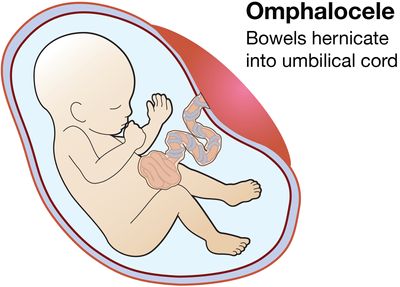
During your pregnancy, you may have had an ultrasound which showed a problem outside your fetus's abdomen. Usually the doctor performing the ultrasound sees a bump on the outside of the abdominal wall. The ultrasound will be able to determine the size of the defect as well as identify the organs that are affected. You will not experience any unusual symptoms during the pregnancy.
What is the outcome for a fetus with omphalocele?
The outcome depends on the size of omphalocele, the presence of other defects, or if there is chromosome abnormalities present or concern for a genetic syndrome. Fetuses with small or medium-sized omphaloceles and no other problems do extremely well with surgical repair after birth. Fetuses with other abnormalities, particularly those with chromosomal defects or genetic syndomes, may have complications after surgical repair due to the other severity of the other problems rather than the omphalocele itself.
The outcome for fetuses with very large or so-called ‘giant’ omphaloceles, even when not associated with other problems, have a very difficult time after birth. Most will survive with a series of difficult operations after birth to return the organs to the abdomen and close the abdominal wall. This can be done with a series of operations in the neonatal period and may require a lengthy hospitalization; alternately, the repair can be delayed months or years. A few of these babies will be left with life-long problems including breathing and feeding difficulties.
How serious is my fetus’s omphalocele?
In order to determine the severity of your fetus's condition it is important to gather information from a variety of tests and determine if there are any additional problems. These tests along with expert guidance are important for you to make the best decision about the proper treatment.
This includes:
- The type of defect—distinguishing it from other similar appearing problems.
- The severity of the defect—is your fetus’s defect mild or severe.
- Associated defects—is there another problem or a cluster of problems (syndrome).
Diagnostic testing with chorionic villus sampling or amniocentesis may be advised for chromosome testing. Sonography is the best imaging tool, but is dependent on the experience and expertise of the physician. Many problems are first detected during routine screening procedures performed in your doctor’s office (amniocentesis, maternal serum screening, routine sonography), but assessment of complex usually requires a tertiary perinatal/neonatal center with experience managing complex and rare fetal problems. We can work with your doctor to find a center convenient for you.
Accurate assessment requires three tests:
- Amniocentesis with microarray to assess the fetal chromosomes
- Level II ultrasound to look for other anomalies and define the anatomy
- Fetal echocardiogram to determine whether or not the fetus has a heart defect
If the chromosomes are normal and there are no additional birth defects other than the omphalocele, the severity of the defect depends entirely on size of the omphalocele. Small omphaloceles are easily repaired with a simple operation and a short stay in the nursery. Large omphaloceles may require staged repair over many weeks in the nursery. Giant omphaloceles require complex reconstruction over weeks, months, or even years.
What are my choices during this pregnancy?
Time intervals for ultrasound studies are decided on an individual basis. Usually, repeat studies are not necessary more than once a month, unless something is changing. For small omphaloceles with no other defects, the baby can be delivered normally at term in a center with pediatric surgeons available. Babies with very small omphaloceles can be safely transported for repair elsewhere, but most will benefit by being repaired shortly after birth in the same unit.
Large and giant omphaloceles should be delivered at a high level tertiary center with pediatric surgery expertise and very good neonatology support. These babies often require prolonged respiratory support during hospitalization. Often, babies with large omphaloceles are delivered by Cesarean section. This is done to minimize the risks to the baby. You and your obstetrician will determine your delivery plan.
What will happen after birth?
Your baby should be born at a hospital with an intensive care nursery and experienced pediatric surgeons. Soon after birth, your child will have surgery to close the opening in the abdominal wall and return the organs to the abdomen. The pediatric surgeon attempts to close the hole at the time of the surgery, but sometimes this is not possible.
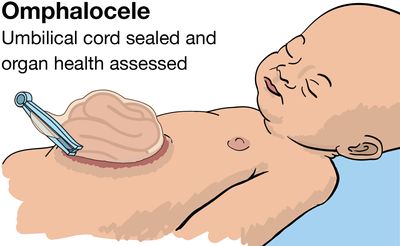
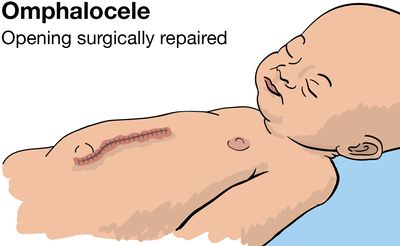
Repair of large omphaloceles and ICN care
Extremely large omphaloceles are not surgically repaired until the baby grows. They are treated by topical application of painless drying agents on the omphalocele membrane. Babies born with omphaloceles can stay in the hospital from one week to months after surgery, depending on the size of the defect. The baby's ability to tolerate feedings and breathe without assistance will determine the length of stay in the hospital. Babies are discharged from the hospital when they are taking all their feedings by mouth and gaining weight. Most babies with small to medium omphaloceles do not have any long-term problems.
After discharge from the hospital, your baby is at risk for bowel obstruction due to scar tissue or a kink in a loop of bowel. Symptoms of bowel obstruction include:
- Bilious (green) vomiting
- A bloated stomach
- No interest in feeding
If any of these symptoms occur, you should contact your pediatrician immediately.
Support Groups & Other Resources
- March of Dimes — Researchers, volunteers, educators, outreach workers and advocates working together to give all babies a fighting chance
- Birth Defect Research for Children — a parent networking service that connects families who have children with the same birth defects
- Kids Health — doctor-approved health information about children from before birth through adolescence
- CDC - Birth Defects — Dept. of Health & Human Services, Centers for Disease Control and Prevention
- NIH - Office of Rare Diseases — National Inst. of Health - Office of Rare Diseases
- North American Fetal Therapy Network — NAFTNet (the North American Fetal Therapy Network) is a voluntary association of medical centers in the United States and Canada with established expertise in fetal surgery and other forms of multidisciplinary care for complex disorders of the fetus.